Type J Electric Plug - Swiss Standard (SEV 1011)
Type J Swiss plug complete guide: compact diamond-shaped three-pin design. Exclusive to Switzerland and Liechtenstein, symbol of Swiss neutrality.
Interactive Type J Plug Animation
Key Facts
History & Development
Type J epitomizes Swiss exceptionalism and precision engineering. Introduced in 1956 as SEV 1011, it was Switzerland's response to the emerging European electrical standards. Rather than adopt German Schuko or French standards, the Swiss created their own - a three-pin system with a unique diamond-shaped configuration that's incompatible with all other plugs.
This decision reflected deep Swiss values: neutrality meant not choosing sides between French and German standards, while the compact, efficient design embodied Swiss minimalism. The plug is notably smaller than Schuko while handling the same current - a triumph of engineering efficiency that allows for more sockets in less space.
The Swiss argued their design was superior: the recessed hexagonal socket prevented finger contact, the offset ground pin ensured correct polarity, and the compact size suited Switzerland's dense urban environments. The fact that it isolated Switzerland electrically was seen as a benefit, not a drawback - maintaining independence was worth the inconvenience.
Liechtenstein adopted Type J through its customs union with Switzerland, and Rwanda surprisingly uses it due to Swiss development aid in the 1970s that included electrical infrastructure. Despite EU pressure to harmonize, Switzerland maintains Type J as steadfastly as it maintains the Swiss Franc - a symbol of independence that every Swiss citizen interacts with daily.
Detailed Technical Specifications
Dimensions
- pins:
- 4.0mm diameter x 19mm
- pin Spacing:
- 19mm between live/neutral
- ground Pin:
- 4.0mm diameter, offset 5mm
- hex Socket:
- Often hexagonal shaped
Performance
- Standard:
- SEV 1011 / SN 441011
- Max Power:
- 2300W at 230V (10A), 3680W (16A T12/T13)
- Test Voltage:
- 2500V for 1 minute
- Temperature:
- -25°C to +70°C operating range
🌍 Real-World Usage Patterns
Most sources just list which countries use Type J, but here's the reality: not all usage is equal. This breakdown shows actual dominance in real outlets.
Traveler's Reality Check
✅ Travelers will find Type J as the dominant plug type in 2 countries. You might encounter it in 1 additional countries, but bring backup adapters.
Advantages & Disadvantages
✓ Advantages
- •Very compact design
- •Recessed socket for safety
- •Diamond pattern ensures correct polarity
- •Efficient use of wall space
- •Robust despite small size
✗ Disadvantages
- •Completely incompatible internationally
- •Requires adapters for all foreign devices
- •Limited to 10A in basic version
- •Expensive for travelers to Switzerland
- •No compatibility with Europlugs in older sockets
Evolution & Modern Developments
Type J evolved through Swiss precision. The original 1956 design was refined in 1986 to accept Europlugs (Type C) - a pragmatic concession to tourism and imported electronics. The T12 variant (16A) was introduced for higher power applications, maintaining the same pin configuration but rated for 3680W.
Modern Swiss sockets often combine T13 (10A) and T23 (16A) in one unit. Safety shutters became standard in 2016. Despite being surrounded by EU countries using incompatible standards, Switzerland shows no intention of changing - Type J is protected by Swiss building codes and deeply embedded infrastructure.
All 3 Countries Using Type J
europe (2 countries)


africa (1 countries)

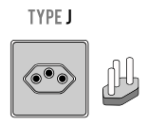
Type J Plug
Quick Specifications
- Pins:
- 3 round pins (diamond)
- Voltage:
- 220-240V
- Current:
- 10A/16A
- Grounding:
- Yes
- Compatibility:
- Accepts C in modern sockets
Global Coverage
Related Plug Types
🧳 Travel Tip
Always check voltage compatibility. Most modern electronics are dual-voltage (100-240V), but older devices may require a voltage converter.
