Type A Electric Plug - The Original American Standard (NEMA 1-15)
Complete guide to Type A plugs: two flat parallel pins, used in 44 countries. History, specifications, safety features, and global compatibility map.
Interactive Type A Plug Animation
Key Facts
History & Development
The Type A plug was invented by Harvey Hubbell II in 1904, revolutionizing electrical connectivity. Before Hubbell's invention, electrical devices were hardwired into the electrical system, making them permanent fixtures. His "Separable Attachment-Plug" patent created the foundation for modern electrical plugs. The design featured two flat parallel blades that could be easily inserted and removed from a socket, transforming how we interact with electrical devices.
The original design has remained remarkably unchanged for over a century, testament to its fundamental soundness. During the 1920s and 1930s, Type A plugs became the de facto standard across North America as electrification spread rapidly. The simplicity of the design made it cheap to manufacture and easy to use, contributing to the rapid adoption of electrical appliances in American homes. Interestingly, Japan adopted the Type A plug in 1915 but with a crucial difference - they use 100V instead of the American 120V. This decision was made for safety reasons, as Japan wanted to minimize electrical accidents during their early electrification period. Today, Type A remains prevalent in over 40 countries, particularly in the Americas and parts of Asia influenced by American electrical standards.
Detailed Technical Specifications
Dimensions
- blade Width:
- 6.35mm
- blade Thickness:
- 1.524mm
- blade Length:
- 15.875-18.256mm
- spacing:
- 12.7mm
Performance
- Standard:
- NEMA 1-15 (ungrounded)
- Max Power:
- 1875W at 125V
- Test Voltage:
- 2500V for 1 minute
- Temperature:
- -25°C to +75°C operating range
🌍 Real-World Usage Patterns
Most sources just list which countries use Type A, but here's the reality: not all usage is equal. This breakdown shows actual dominance in real outlets.
Traveler's Reality Check
✅ Travelers will find Type A as the dominant plug type in 16 countries. You might encounter it in 27 additional countries, but bring backup adapters. In 1 countries, it's mostly in old buildings.
Advantages & Disadvantages
✓ Advantages
- •Simple and economical design
- •Compact size suitable for small devices
- •Widely available worldwide
- •Compatible with Type B sockets
- •Low manufacturing cost
✗ Disadvantages
- •No grounding protection
- •Can be inserted reversed (no polarization enforcement)
- •Blades can bend or break
- •Can partially fall out of worn sockets
- •No protection against accidental contact
Evolution & Modern Developments
The Type A plug has seen several evolutionary improvements despite maintaining its basic design. In 1928, polarized plugs were introduced with one blade wider than the other to ensure correct insertion orientation, crucial for devices where the live and neutral connections matter.
The 1960s saw the introduction of hospital-grade plugs with more robust construction and tighter tolerances. Modern Type A plugs often feature partially insulated blades to prevent accidental contact when partially inserted. Some manufacturers now produce tamper-resistant receptacles that require simultaneous insertion of both blades to open safety shutters.
All 44 Countries Using Type A
north-america (18 countries)


africa (5 countries)


oceania (4 countries)


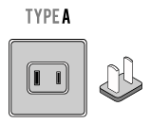
Type A Plug
Quick Specifications
- Pins:
- 2 flat parallel pins
- Voltage:
- 100-127V
- Current:
- 15A
- Grounding:
- No
- Compatibility:
- Works in Type B sockets
Global Coverage
Related Plug Types
🧳 Travel Tip
Remember that North American plugs operate at 120V. If traveling from Europe or Asia, you'll need both an adapter AND a voltage converter for high-power devices.
