Type B Electric Plug - Grounded North American Standard (NEMA 5-15)
Comprehensive Type B plug guide: grounded 3-pin design with two flat pins plus round grounding pin. Used in USA, Canada, Mexico, and 20+ countries worldwide.
Interactive Type B Plug Animation
Key Facts
History & Development
The Type B plug emerged in 1928 when Philip F. Labre, while working for Hubbell, invented the grounding pin addition to the existing Type A design. This innovation came in response to increasing electrical accidents and the need for better safety in electrical appliances. The grounding pin was a revolutionary safety feature that provided a path for fault current to flow to earth rather than through a person.
The adoption of Type B was gradual but steady throughout the 1930s and 1940s, accelerating after World War II when electrical codes began requiring grounded outlets for certain applications. The National Electrical Code (NEC) in the United States began mandating grounded receptacles in specific locations starting in 1947, beginning with laundry areas and gradually expanding to kitchens, bathrooms, and eventually all areas.
The design philosophy behind Type B was elegant in its simplicity: the ground pin is longer than the power blades, ensuring it makes contact first when inserting and breaks contact last when removing. This sequence ensures the device is always grounded when power is present. The round shape of the ground pin also prevents it from being inserted into older Type A outlets, enforcing the safety upgrade.
Detailed Technical Specifications
Dimensions
- blade Width:
- 6.35mm
- blade Thickness:
- 1.524mm
- blade Length:
- 15.875-18.256mm
- spacing:
- 12.7mm
- ground Pin:
- 4.8mm diameter, 19.05mm long
Performance
- Standard:
- NEMA 5-15 (grounded)
- Max Power:
- 1875W at 125V
- Test Voltage:
- 2500V for 1 minute
- Temperature:
- -40°C to +75°C operating range
🌍 Real-World Usage Patterns
Most sources just list which countries use Type B, but here's the reality: not all usage is equal. This breakdown shows actual dominance in real outlets.
Traveler's Reality Check
✅ Travelers will find Type B as the dominant plug type in 25 countries. You might encounter it in 13 additional countries, but bring backup adapters.
Advantages & Disadvantages
✓ Advantages
- •Grounding protection against electrical shock
- •Ground pin ensures correct orientation
- •Backwards compatible (accepts Type A plugs)
- •Robust construction
- •Required by code for many applications
✗ Disadvantages
- •Larger than Type A
- •Ground pin can break off if mishandled
- •Not compatible with Type A-only outlets
- •Still allows partial exposure of live blades
- •No shutters on standard versions
Evolution & Modern Developments
Type B has evolved significantly since 1928. The 1950s saw the introduction of the U-ground configuration where the ground pin faces up, becoming the standard orientation. In 1962, the twist-lock variant (NEMA L5-15) was developed for applications requiring secure connections.
The 1990s brought tamper-resistant receptacles (TRR) with spring-loaded shutters that require simultaneous insertion of all three prongs. In 2008, the National Electrical Code began requiring TRRs in new residential construction. Modern Type B outlets often include GFCI (Ground Fault Circuit Interrupter) or AFCI (Arc Fault Circuit Interrupter) protection for enhanced safety.
Recent innovations include USB-integrated outlets, smart outlets with WiFi connectivity, and outlets with built-in surge protection. The fundamental Type B design has proven so successful that it remains the North American standard despite various attempts at introducing alternatives.
All 38 Countries Using Type B
north-america (18 countries)


asia (6 countries)


africa (5 countries)


oceania (4 countries)


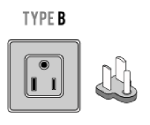
Type B Plug
Quick Specifications
- Pins:
- 2 flat pins + 1 round grounding pin
- Voltage:
- 100-127V
- Current:
- 15A
- Grounding:
- Yes
- Compatibility:
- Accepts Type A plugs
Global Coverage
Related Plug Types
🧳 Travel Tip
Remember that North American plugs operate at 120V. If traveling from Europe or Asia, you'll need both an adapter AND a voltage converter for high-power devices.
