Type M Electric Plug - South African Standard (SANS 164-1)
Type M plug complete guide: heavy-duty 15-amp British colonial standard. Largest domestic plug pins. Used in South Africa, Namibia, and Swaziland.
Interactive Type M Plug Animation
Key Facts
History & Development
Type M represents South Africa's unique electrical evolution, rooted in British colonial history but adapted for African conditions. Based on the British BS 546 15-amp standard (a larger version of Type D), it was formalized in 1947 as SABS 164-1. The massive 15-amp round pins were designed to handle South Africa's mining equipment and agricultural machinery - this wasn't a domestic plug originally, but an industrial standard that became residential.
The apartheid era saw Type M become entrenched as South Africa isolated itself from international standards. The plug's incompatibility with the rest of the world mirrors the country's political isolation during this period. Ironically, this isolation protected South African electrical manufacturers, creating a captive market that made several companies very wealthy.
The plug's robustness suited South African conditions - from the humidity of Durban to the dry heat of the Karoo, from urban Johannesburg to rural farms without stable power. The large pins handle voltage fluctuations better than delicate modern plugs, important in a country with significant infrastructure challenges.
Post-apartheid South Africa considered adopting international standards, but the cost of replacing millions of sockets proved prohibitive. In 2013, South Africa announced adoption of Type N as the new standard, but Type M remains dominant. Neighboring countries like Namibia, Swaziland (Eswatini), and Lesotho use Type M due to South African influence, creating a southern African electrical zone.
Detailed Technical Specifications
Dimensions
- live Pins:
- 7.05mm diameter x 18.15mm
- earth Pin:
- 8.7mm diameter x 28.5mm
- pin Spacing:
- 25.4mm triangular
- current:
- 15A standard
Performance
- Standard:
- SANS 164-1 (formerly SABS 164-1)
- Max Power:
- 3450W at 230V (15A)
- Test Voltage:
- 3000V for 1 minute
- Temperature:
- -10°C to +55°C operating range
🌍 Real-World Usage Patterns
Most sources just list which countries use Type M, but here's the reality: not all usage is equal. This breakdown shows actual dominance in real outlets.
Traveler's Reality Check
✅ Travelers will find Type M as the dominant plug type in 5 countries. You might encounter it in 2 additional countries, but bring backup adapters.
Advantages & Disadvantages
✓ Advantages
- •Extremely robust construction
- •Handles 15A without heating
- •Large pins resist damage
- •Good for unstable power conditions
- •Deep insertion provides secure connection
✗ Disadvantages
- •Bulky and space-consuming
- •Incompatible globally
- •Overkill for most domestic appliances
- •Expensive adapters required
- •Being phased out for Type N
Evolution & Modern Developments
Type M's evolution reflects South Africa's changing politics. The post-apartheid government's 2013 decision to adopt Type N (IEC 60906-1) aimed to align with international standards, but implementation has been slow. New buildings might have Type N, but Type M dominates existing infrastructure.
Modern South African sockets sometimes combine Type M with Type C (Europlug) compatibility. Load-shedding (rolling blackouts) has made surge-protected Type M plugs popular. The transition to Type N is expected to take 50+ years, making Type M a persistent standard despite official phase-out.
All 7 Countries Using Type M
africa (6 countries)


asia (1 countries)

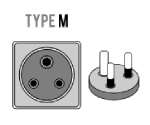
Type M Plug
Quick Specifications
- Pins:
- 3 large round pins
- Voltage:
- 220-240V
- Current:
- 15A
- Grounding:
- Yes
- Compatibility:
- None
Global Coverage
Related Plug Types
🧳 Travel Tip
Always check voltage compatibility. Most modern electronics are dual-voltage (100-240V), but older devices may require a voltage converter.
