Type D Electric Plug - BS 546 Round Pin (India Standard)
Type D plug complete guide: British colonial legacy with three round pins. Standard in India, Pakistan, Bangladesh, Sri Lanka, and Nepal. Used by over 1.3 billion people.
Interactive Type D Plug Animation
Key Facts
History & Development
Type D plugs, officially known as BS 546, originated in the British Empire during the height of colonial expansion. Introduced in 1915, this three-pin round plug became the standard across British territories, from India to South Africa, from Hong Kong to the Middle East. The design featured three round pins in a triangular configuration, with the earth pin being thicker than the live and neutral pins.
The plug was designed for tropical conditions - the large pins and robust construction could withstand humidity, dust, and temperature extremes better than contemporary alternatives. This made it ideal for the challenging environments of British colonies. The 5-amp version became standard for lighting circuits, while 15-amp variants powered heavier appliances.
India's relationship with Type D is particularly fascinating. After independence in 1947, while Britain moved to Type G, India retained Type D as its primary standard. This decision was partly economic - replacing millions of existing outlets would have been prohibitively expensive - and partly practical, as the robust design suited India's diverse climate conditions. Today, India represents the largest user base of Type D plugs, with over 1.3 billion people using this "colonial legacy" daily.
The persistence of Type D in former British territories creates an interesting historical map of the British Empire. Countries still using Type D today include India, Pakistan, Bangladesh, Sri Lanka, Nepal, and parts of Africa - essentially tracing the footprint of British colonial influence in electrical infrastructure.
Detailed Technical Specifications
Dimensions
- live Pins:
- 5.08mm diameter x 19.05mm
- earth Pin:
- 7.06mm diameter x 20.6mm
- pin Spacing:
- 19.05mm triangular
- variants:
- 5A, 15A, and 30A versions
Performance
- Standard:
- BS 546
- Max Power:
- 1150W at 230V (5A), 3450W (15A)
- Test Voltage:
- 2000V for 1 minute
- Temperature:
- -10°C to +55°C operating range
🌍 Real-World Usage Patterns
Most sources just list which countries use Type D, but here's the reality: not all usage is equal. This breakdown shows actual dominance in real outlets.
Traveler's Reality Check
✅ Travelers will find Type D as the dominant plug type in 10 countries. You might encounter it in 15 additional countries, but bring backup adapters. In 1 countries, it's mostly in old buildings.
Advantages & Disadvantages
✓ Advantages
- •Robust construction for harsh environments
- •Good contact pressure with round pins
- •Earth pin prevents reverse insertion
- •Works well in high humidity
- •Simple, reliable design
✗ Disadvantages
- •No shuttered sockets in standard version
- •Large size for the current rating
- •Pins can become loose over time
- •Not compatible with modern compact devices
- •Limited to specific former British territories
Evolution & Modern Developments
Type D has remained remarkably unchanged since 1915, a testament to its fundamental soundness. India has made some modernizations: shuttered sockets became available in the 1980s, and combination sockets accepting both Type C (Europlug) and Type D became common in the 2000s.
South Africa used Type D until the 1990s when they began transitioning to Type M (larger version of the same design) and later to Type N. Nepal and Pakistan continue using Type D alongside Type C and Type M. Modern Indian manufacturers produce "universal" sockets that accept Type C, D, and M plugs, reflecting the country's electrical diversity.
All 26 Countries Using Type D


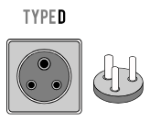
Type D Plug
Quick Specifications
- Pins:
- 3 round pins (triangular)
- Voltage:
- 220-240V
- Current:
- 5A/15A
- Grounding:
- Yes
- Compatibility:
- None
Global Coverage
Related Plug Types
🧳 Travel Tip
Always check voltage compatibility. Most modern electronics are dual-voltage (100-240V), but older devices may require a voltage converter.
