Type G Electric Plug - British Standard with Built-in Fuse (BS 1363)
Type G British plug complete guide: the world's safest plug design with three rectangular pins and integrated fuse. Used in UK, Ireland, Singapore, Malaysia, and 50+ countries.
Interactive Type G Plug Animation
Key Facts
History & Development
The Type G plug emerged from tragedy and necessity in post-World War II Britain. During the war, Britain faced a copper shortage, and after the war, the country needed to rebuild its bombed infrastructure efficiently. The Electrical Installation Committee, led by Dame Caroline Haslett, was tasked with creating a new electrical standard that would be safe, use minimal materials, and support Britain's reconstruction.
The resulting BS 1363 standard, introduced in 1947, was revolutionary. Each plug contained its own fuse, a unique feature that allowed the use of ring circuits - a wiring method that used less copper than traditional radial circuits. This was crucial for post-war Britain, where copper was scarce and expensive. The ring circuit could deliver 30 amps to multiple sockets using thinner wire than would otherwise be required.
The three rectangular pins were arranged to be incompatible with any existing plug type, forcing a complete infrastructure renewal. The earth pin was made longer and positioned to open safety shutters in the socket, preventing children from inserting objects into live contacts. This design was so advanced that many consider it the safest plug design ever created.
The plug's adoption was mandated in all new British construction from 1947, and by the 1960s, it had completely replaced older round-pin plugs. Former British colonies largely adopted the standard, making it one of the most widespread plug types globally, used by over 750 million people today.
Detailed Technical Specifications
Dimensions
- live Pins:
- 6.35mm x 4.0mm x 17.7mm
- earth Pin:
- 8.0mm x 4.0mm x 22.2mm
- pin Spacing:
- 22.2mm (live/neutral), 22.2mm to earth
- fuse Size:
- 25.4mm x 6.3mm cartridge
Performance
- Standard:
- BS 1363
- Max Power:
- 3120W at 240V (13A fused)
- Test Voltage:
- 3000V for 1 minute
- Temperature:
- -5°C to +40°C operating range
🌍 Real-World Usage Patterns
Most sources just list which countries use Type G, but here's the reality: not all usage is equal. This breakdown shows actual dominance in real outlets.
Traveler's Reality Check
✅ Travelers will find Type G as the dominant plug type in 40 countries. You might encounter it in 10 additional countries, but bring backup adapters.
Advantages & Disadvantages
✓ Advantages
- •Integrated fuse provides device-specific protection
- •Safety shutters prevent foreign object insertion
- •Longer earth pin ensures grounding before power
- •Partially insulated pins prevent shock
- •Robust construction resists damage
- •Cable exits downward reducing strain
✗ Disadvantages
- •Large and bulky design
- •Painful if stepped on
- •Fuse replacement required for faults
- •Not compatible with any other standard
- •Expensive to manufacture
Evolution & Modern Developments
The Type G plug has seen continuous refinement since 1947. The original design used 15-amp and 5-amp fuses; 3-amp and 13-amp became standard in the 1950s. Pin sleeves (insulation on the live and neutral pins) became mandatory in 1984, preventing accidental contact.
The 1990s saw the introduction of molded plugs that couldn't be opened, improving safety but preventing fuse replacement. Modern variants include USB charging ports, Wi-Fi smart plugs, and timer-controlled versions. Despite various attempts to harmonize with European standards, Britain has retained Type G, with Brexit reinforcing this decision.
Safety improvements continue: modern sockets have improved shutter mechanisms, and some feature built-in RCD protection. The design has proven so successful that the United Arab Emirates adopted it in 2009, and Saudi Arabia is transitioning to it from 2010 onwards.
All 50 Countries Using Type G
middle-east (10 countries)


asia (12 countries)


africa (17 countries)


europe (4 countries)


north-america (5 countries)


south-america (1 countries)

oceania (1 countries)

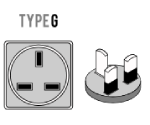
Type G Plug
Quick Specifications
- Pins:
- 3 rectangular pins
- Voltage:
- 220-240V
- Current:
- 13A
- Grounding:
- Yes
- Compatibility:
- None
Global Coverage
Related Plug Types
🧳 Travel Tip
Always check voltage compatibility. Most modern electronics are dual-voltage (100-240V), but older devices may require a voltage converter.
