Type F Electric Plug - Schuko German Standard (CEE 7/4)
Type F Schuko plug complete guide: German standard with two round pins and side grounding clips. Used by 400+ million Europeans from Portugal to Russia.
Interactive Type F Plug Animation
Key Facts
History & Development
The Type F plug, universally known as "Schuko" (short for Schutzkontakt, meaning "protective contact"), was patented by Albert Büttner in 1926 as "Stecker mit Schutzkontakt". This German innovation introduced a revolutionary grounding system using spring clips on the sides, creating a secure earth connection before the live pins made contact.
Schuko emerged during the Weimar Republic's industrial boom, when Germany was rapidly electrifying and workplace electrical accidents were common. The design prioritized safety and robustness - the recessed socket prevented accidental contact, while the side clips provided grounding without requiring a third pin. This elegant solution allowed for reversible insertion while maintaining safety.
The plug's adoption accelerated under the Nazi regime's standardization efforts in the 1930s, ironically making it one of the few positive legacies of that era's industrial policies. Post-WWII, divided Germany maintained Schuko in both East and West, and it spread throughout Central and Eastern Europe, becoming the de facto standard from Portugal to Russia.
Today, Schuko is used by over 400 million people across Europe. Its success lies in German engineering philosophy: over-engineered for safety, built to last decades, and standardized rigorously. The 16-amp rating (3,680 watts) handles most household appliances, while the robust construction survives industrial use.
Detailed Technical Specifications
Dimensions
- pins:
- 4.8mm diameter x 19mm
- pin Spacing:
- 19mm
- earth Clips:
- Side spring clips, 4mm wide
- recess Depth:
- 17.5mm minimum
Performance
- Standard:
- CEE 7/4 (Schuko)
- Max Power:
- 3680W at 230V (16A)
- Test Voltage:
- 2500V for 1 minute
- Temperature:
- -25°C to +70°C operating range
🌍 Real-World Usage Patterns
Most sources just list which countries use Type F, but here's the reality: not all usage is equal. This breakdown shows actual dominance in real outlets.
Traveler's Reality Check
✅ Travelers will find Type F as the dominant plug type in 43 countries. You might encounter it in 16 additional countries, but bring backup adapters.
Advantages & Disadvantages
✓ Advantages
- •Robust side clip grounding system
- •Reversible insertion
- •Deep recess prevents accidental contact
- •High 16A current rating
- •Compatible with CEE 7/7 and Type C plugs
- •Excellent mechanical strength
✗ Disadvantages
- •Bulky design requires space
- •Not compatible with French Type E sockets
- •Side clips can weaken over time
- •Expensive to manufacture
- •Deep wall boxes required
Evolution & Modern Developments
Schuko's evolution reflects German industrial perfectionism. The 1970s brought partially insulated pins, preventing shock if touched during insertion. The 1980s saw the CEE 7/7 compromise plug that works in both German and French sockets.
Modern improvements include shuttered sockets (mandatory in Germany since 1973), sockets with integrated RCD protection, and orientation-specific variants for data-sensitive equipment. Smart Schuko sockets with WiFi control and energy monitoring are now common. Despite EU harmonization attempts, Germany steadfastly maintains Schuko, viewing alternatives as inferior compromises.
All 59 Countries Using Type F
asia (10 countries)


europe (35 countries)


africa (7 countries)


middle-east (5 countries)


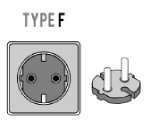
Type F Plug
Quick Specifications
- Pins:
- 2 round pins + side clips
- Voltage:
- 220-240V
- Current:
- 16A
- Grounding:
- Yes (side clips)
- Compatibility:
- Accepts C and E/F hybrid
Global Coverage
Related Plug Types
🧳 Travel Tip
Always check voltage compatibility. Most modern electronics are dual-voltage (100-240V), but older devices may require a voltage converter.
