Type E Electric Plug - French Standard (CEE 7/5)
Type E French plug complete guide: two round pins with ground pin receptor. Used in France, Belgium, Poland, Czech Republic, Slovakia, and former French colonies.
Interactive Type E Plug Animation
Key Facts
History & Development
The Type E plug represents France's determination to maintain electrical independence during European integration. Developed in 1959 as French standard NF C 61-314, it was France's answer to the German Schuko plug (Type F). While Germany developed a plug with side clips for grounding, France chose a protruding earth pin in the socket - a seemingly small difference that would affect millions of travelers for decades to come.
This decision wasn't merely technical; it was deeply political. Post-war Europe saw nations protecting their industrial standards as matters of national pride and economic interest. France had invested heavily in their electrical infrastructure and changing to the German standard would have meant admitting German technical superiority - unthinkable in the political climate of the time.
The Type E design actually offers some advantages: the earth pin connection is more reliable than side clips, and the recessed socket design provides better protection against accidental contact. French engineers argued their design was superior for safety, particularly in preventing children from touching live contacts.
Belgium, Poland, Czechia, Slovakia, and several former French colonies adopted Type E, creating a francophone electrical zone. The modern CEE 7/7 plug, which works in both French Type E and German Type F sockets, represents one of the most successful examples of European technical compromise, though pure Type E plugs remain common in France.
Detailed Technical Specifications
Dimensions
- pins:
- 4.8mm diameter x 19mm
- pin Spacing:
- 19mm
- earth Pin:
- 4.8mm diameter x 14mm (socket protrusion)
- recess Depth:
- 15mm
Performance
- Standard:
- NF C 61-314, CEE 7/5
- Max Power:
- 3680W at 230V (16A)
- Test Voltage:
- 2500V for 1 minute
- Temperature:
- -25°C to +70°C operating range
🌍 Real-World Usage Patterns
Most sources just list which countries use Type E, but here's the reality: not all usage is equal. This breakdown shows actual dominance in real outlets.
Traveler's Reality Check
✅ Travelers will find Type E as the dominant plug type in 23 countries. You might encounter it in 6 additional countries, but bring backup adapters.
Advantages & Disadvantages
✓ Advantages
- •Recessed socket prevents accidental contact
- •Reliable earth pin connection
- •Compatible with CEE 7/7 hybrid plugs
- •Robust 16A capacity
- •Partially insulated pins on modern versions
✗ Disadvantages
- •Not compatible with German Type F
- •Earth pin can break if forced
- •Requires deep wall boxes
- •Cannot be used with flat wall-mount devices
- •Limited international compatibility
Evolution & Modern Developments
The evolution of Type E reflects European integration struggles. The 1980s saw the development of the CEE 7/7 plug, which brilliantly works in both French and German sockets by combining side clips with a hole for the French earth pin. This compromise plug is now standard on most appliances sold in Continental Europe.
Modern French sockets often include safety shutters (introduced in 1991) and some feature built-in USB charging ports. The pure Type E plug (CEE 7/5) is becoming rarer, replaced by the universal CEE 7/7, though millions of Type E sockets remain installed across France and Belgium.
All 29 Countries Using Type E


africa (23 countries)


asia (2 countries)


middle-east (1 countries)

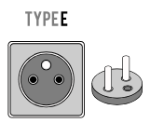
Type E Plug
Quick Specifications
- Pins:
- 2 round pins + ground pin receptor
- Voltage:
- 220-240V
- Current:
- 16A
- Grounding:
- Yes (pin in socket)
- Compatibility:
- Accepts C and E/F hybrid
Global Coverage
Related Plug Types
🧳 Travel Tip
Always check voltage compatibility. Most modern electronics are dual-voltage (100-240V), but older devices may require a voltage converter.
