Type C Electric Plug - The Universal Europlug (CEE 7/16)
Type C Europlug complete guide: most widely used international plug with two round pins. Compatible with 130+ countries across Europe, Asia, Africa, and South America.
Interactive Type C Plug Animation
Key Facts
History & Development
The Type C plug, known as the Europlug, represents one of the most successful international standardization efforts in electrical history. Developed by the International Electrotechnical Commission (IEC) in 1963 as CEE 7/16, it was designed to be a universal solution for low-power devices across Europe, addressing the chaos of incompatible national standards that emerged after World War II.
The design process took over a decade of negotiations between European nations, each protecting their existing electrical infrastructure investments. The breakthrough came when engineers proposed a slim, 2.5-amp limited plug that could fit into virtually any European socket accepting 4.0-4.8mm round contacts with 19mm spacing. This meant it could work in German Schuko, French, Italian, Swiss, Danish, and many other national sockets.
The Europlug's adoption was remarkably swift. By 1970, most European manufacturers were using it for radios, shavers, and small appliances. The European Union's formation accelerated standardization, and by 1990, the Europlug had become ubiquitous. Today, it's used in over 130 countries, making it the most widely compatible plug design in the world. Its success lies not in being perfect, but in being good enough for everyone - a masterclass in international compromise.
Detailed Technical Specifications
Dimensions
- pin Diameter:
- 4.0mm at tip, 4.8mm at base
- pin Length:
- 19mm
- pin Spacing:
- 18.6mm at tip, 19mm at base
- body Width:
- Maximum 35.3mm
Performance
- Standard:
- CEE 7/16 (Europlug)
- Max Power:
- 575W at 230V (2.5A limit)
- Test Voltage:
- 2500V for 1 minute
- Temperature:
- -25°C to +70°C operating range
🌍 Real-World Usage Patterns
Most sources just list which countries use Type C, but here's the reality: not all usage is equal. This breakdown shows actual dominance in real outlets.
Traveler's Reality Check
✅ Travelers will find Type C as the dominant plug type in 33 countries. You might encounter it in 87 additional countries, but bring backup adapters. In 2 countries, it's mostly in old buildings.
Advantages & Disadvantages
✓ Advantages
- •Universal compatibility across Europe
- •Slim design fits recessed sockets
- •Partially insulated pins for safety
- •Flexible pins accommodate socket variations
- •No live blade exposure when partially inserted
✗ Disadvantages
- •No grounding capability
- •Limited to 2.5A (575W at 230V)
- •Can feel loose in some sockets
- •Not suitable for high-power devices
- •Pins can bend under stress
Evolution & Modern Developments
The Europlug's evolution reflects European integration. The original 1963 design had straight pins, but the 1990 revision introduced slightly convergent pins (narrower at the tips) to ensure better contact in various socket types. The pins are also flexible, bending up to 5 degrees to accommodate socket variations.
Modern Europlugs feature partially insulated pins - the first 10mm from the body are insulated, preventing accidental contact when partially inserted. This safety feature became mandatory in 1994. Some manufacturers now produce reinforced versions with thicker pins for frequent insertion/removal cycles.
The success of Type C influenced the development of the IEC 60906-1 standard (Type N), which aims to be a universal grounded plug. However, the Europlug's installed base is so vast that it will likely remain in use for decades to come.
All 122 Countries Using Type C
asia (21 countries)


europe (40 countries)
 Albania
 Austria
 Belarus
 Belgium
 Bosnia and Herzegovina
 Bulgaria
 Croatia
 Czech Republic
 Denmark
 Estonia
 Finland
 France
 Germany
 Greece
 Hungary
 Iceland
 Italy
Italy Latvia
 Liechtenstein
 Lithuania
 Luxembourg
 Moldova
 Monaco
 Montenegro
 Netherlands
 North Macedonia
 Norway
 Poland
 Portugal
 Romania
 Russia
 San Marino
 Serbia
 Slovakia
 Slovenia
 Spain
Spain Sweden
 Switzerland
 Ukraine
 Vatican City
africa (44 countries)
 Algeria
 Benin
Benin Burkina Faso
 Burundi
 Cabo Verde
 Cameroon
 Central African Republic
 Chad
Chad Comoros
 Congo
Congo Côte d'Ivoire
 Democratic Republic of the Congo
 Djibouti
 Egypt
Egypt Equatorial Guinea
 Eritrea
 Ethiopia
 Gabon
Gabon Greenland
 Guinea
 Guinea-Bissau
 Libya
Libya Madagascar
 Mali
Mali Mauritania
 Mauritius
 Morocco
 Mozambique
 Niger
Niger Rwanda
 Saint Barthélemy
 Saint Martin
 São Tomé and Príncipe
 Senegal
 Somalia
 South Africa
 South Sudan
 Sudan
Sudan Svalbard
 Togo
Togo Tunisia
 Wallis and Futuna
 Western Sahara
 Zambia


north-america (1 countries)

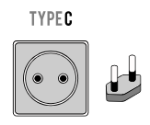
Type C Plug
Quick Specifications
- Pins:
- 2 round pins (4.0-4.8mm)
- Voltage:
- 220-240V
- Current:
- 2.5A
- Grounding:
- No
- Compatibility:
- Works in E, F, J, K, L sockets
Global Coverage
Related Plug Types
🧳 Travel Tip
The Europlug is limited to 2.5 amps. It's perfect for phone chargers and small electronics but won't work for hair dryers or other high-power devices.
